Estudio De Las Sectas Josh Mcdowell Pdf [patched] Info
For the most accurate results from NormalizeScaleGradient,
you need to purchase a license for the C++ module NSGXnml.
This runs in the background and enables all of
NSG's extra capabilities. See the
Purchase page.
Customer Reviews (NSG)
Estudio De Las Sectas Josh Mcdowell Pdf [patched] Info
Proporciona a los creyentes una base sólida para discernir entre la doctrina bíblica y la falsa doctrina.
The book provides detailed summaries and critiques of various movements, including: www.buscalibre.es Understanding the Cults by Josh McDowell - Goodreads
Escrito por Josh McDowell, un reconocido apologista cristiano, y Don Stewart, este libro no es solo una crítica, sino un manual educativo que busca y las doctrinas de diversos grupos sectarios.
No lea pasivamente. Abra su Biblia y verifique cada cita. Escriba las respuestas a las objeciones más comunes. Cree sus propias tarjetas de estudio.
Revisando cómo redefinen conceptos como el pecado y la muerte. Cómo Utilizar el Estudio de las Sectas de Josh McDowell estudio de las sectas josh mcdowell PDF
¿Te interesa conocer qué otros temas aborda la obra de McDowell? Si quieres, puedo explicarte su enfoque sobre la historicidad de la Biblia o cómo aborda el escepticismo en sus otros libros. Share public link
El análisis de las enseñanzas de Sun Myung Moon y su concepto de la familia ideal.
Proporciona acceso a un material que puede estar agotado en formato físico en algunas librerías.
Las sectas rara vez utilizan la Biblia de forma exclusiva o literal. Suelen añadir revelaciones modernas, libros sagrados adicionales (como el Libro de Mormón) o interpretaciones infalibles de un líder u organización (como las publicaciones de la Sociedad Watch Tower). Proporciona a los creyentes una base sólida para
El libro (título original en inglés: Understanding the Cults ), escrito por los reconocidos apologistas Josh McDowell y Don Stewart , es uno de los manuales de referencia más consultados en el ámbito cristiano hispanohablante para analizar los movimientos religiosos alternativos. Publicado originalmente por la editorial Editorial Vida , este texto dota a los lectores de herramientas teológicas para confrontar doctrinas contrarias al cristianismo histórico sin recurrir a la ofensa personal.
El sigue siendo una herramienta de un valor incalculable para la iglesia del siglo XXI. En un mundo hiperconectado donde el relativismo espiritual abunda y nuevas corrientes religiosas surgen constantemente en las redes sociales, los principios de análisis teológico desarrollados por McDowell ofrecen un faro de claridad y verdad.
Explicaciones directas a preguntas existenciales complejas en tiempos de incertidumbre.
McDowell analiza algunas de las sectas más conocidas, como:
Las sectas fomentan un aislamiento psicológico y, a veces, físico. Enseñan que ellos son el único remanente verdadero sobre la Tierra y que cualquier persona o institución fuera de sus filas —incluyendo las iglesias cristianas tradicionales— está bajo el control del error o de fuerzas demoníacas. Esto genera un fuerte lazo de dependencia y temor a abandonar el grupo. Grupos Analizados en la Apologética de McDowell
Analizando su visión sobre Cristo y la Trinidad.
Xu Kang, May 2025
... Your dedication to advancing astrophotography post-processing deserves sincere appreciation.
I look forward to pushing the boundaries of imaging with these sophisticated algorithms.
Sky at Night magazine, October 2023, p78
Mathew Ludgate, Astronomy Photographer of the year shortlisted entrant in the 'Stars and Nebulae' category:
... After using the WBPP script in PixInsight to perform image calibration and registration,
I utilised the Normalize Scale Gradient (NSG) script by John Murphy.
This corrects the brightness and gradient of your subs using
differential photometry to model the relative scales and gradients.
I image at a dark site but I still find NSG very useful as a first step...
Paul Denny, 2023
... thank you for writing this script [NSG]
and making it available to the astrophotography community.
I am quite new to this and still on a steep learning curve,
but I do know enough to see what a great tool this is,
as is your excellent documentation and YouTube videos.
I feel as though I understand and have control over this part
of the processing flow for the first time.
AdamBlockStudios, Adam Block, 2022
... I helped (with some advice and ideas) the brilliant John Murphy as he crafted NormalizeScaleGradient (NSG).
The normalization and weighting of data is a fundamental and critical component of image processing.
NormalizeScaleGradient (NSG) normalizes the scale and gradient to that of the reference image.
Differential stellar photometry is used to determine the scale, and a surface spline to model the relative gradient.
It is designed to achieve the following goals:
Scaling the target images: This involves multiplying each target image by a factor to
make its (brightness) scale match that of the reference image. This has to be done before gradient removal.
Relative gradient removal: After normalization, all the target frames
will only contain the gradient present in the reference image.
By choosing the reference image carefully, the overall gradient is reduced and simplified.
Image weights: Calculate image weights using the scientifically correct formula
(signal to noise ratio)²
Accurate normalization is crucial for good data rejection while stacking.
Finding the best reference image
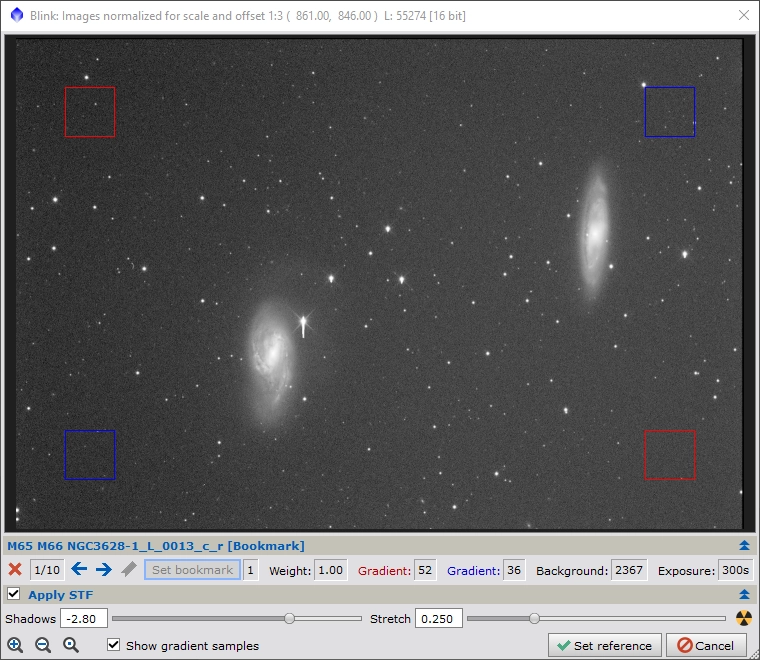
PixInsight already includes a blink tool, but for judging gradients, the displayed images can be misleading.
The reason for this is it's difficult to display all the images in a completely fair way;
The STF and Histogram functions do not accurately normalize the images.
An image with a large gradient is likely to be scaled differently to an image without light pollution.
This makes it difficult to determine how the image gradients compare.
The NSG blink dialog is specialized for finding the best reference image:
Normalizes all the images for scale and offset. This normalization corrects the average background level, but not the gradient.
Displays the original background level, and an estimate of the gradient in two different directions.
Sorts the blink images by NWEIGHT.
Integer zoom to allow individual pixel inspection without interpolation. The window is resizable, with scrollbars when needed.
Ability to blink between the current image and a bookmarked image.
Ability to control the STF that is applied to all the images.
Maximize available screen space.
Automatically releases memory after the dialog is closed.
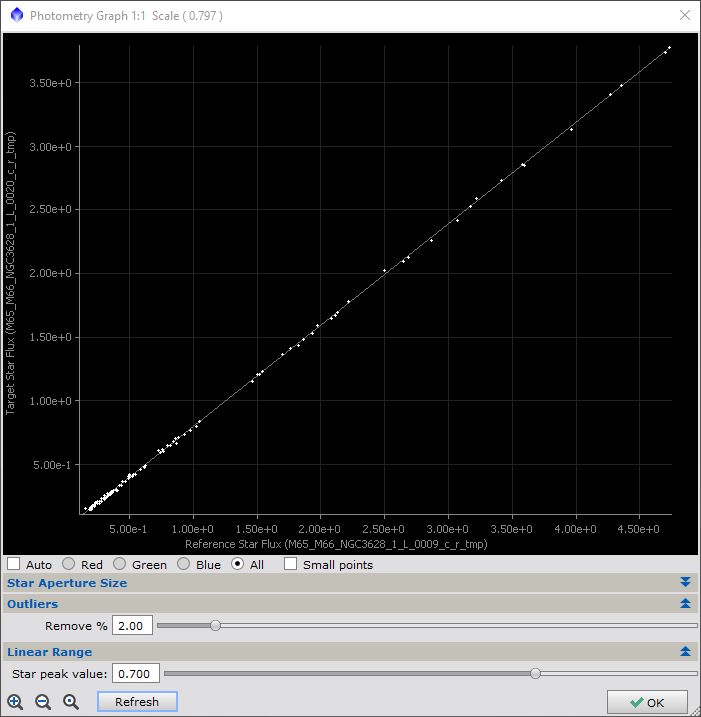
Accurate scale factor
Photometry is used to determine a very accurate (brightness) scale factor.
Great care is taken to ensure that exactly the same stars are used in the
reference and target images.
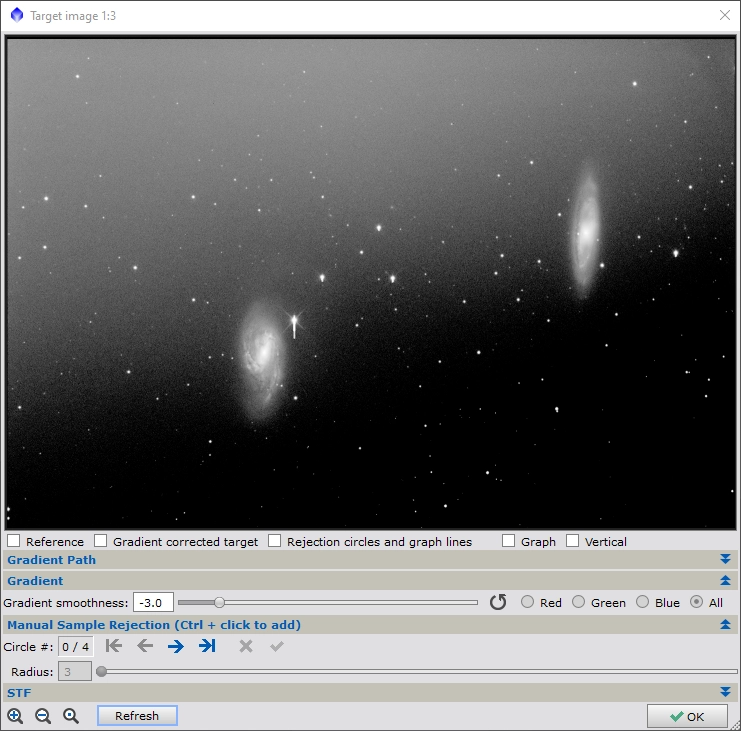
Gradient correction: What you see is what you get.
Mouse over the image to display the gradient correction.
This simulates the user toggling the 'Gradient corrected target' checkbox.
If the reference checkbox is not selected (as in this example),
it blinks between the uncorrected and corrected target image.
If the reference checkbox is selected,
it blinks between the reference image and corrected target image.
Modify the 'Gradient smoothness' until the correction is excellent.
What you see is what you get, making it easy to achieve optimum results.
It is important to understand that NSG
is designed to make the target image's gradient match
the reference image. Any gradient in the reference image will remain and must be removed
after stacking with a process such as DynamicBackgroundExtraction.
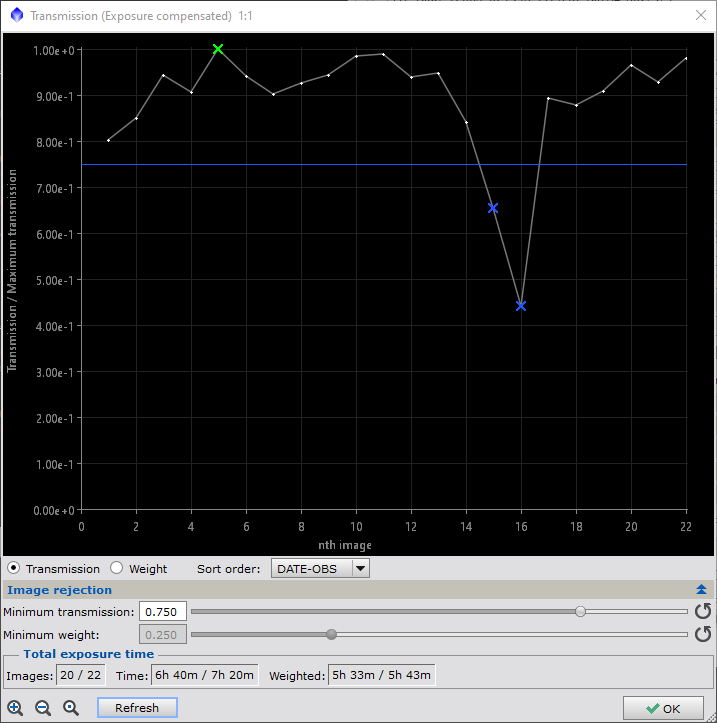
Transmission graph: Detect the clouds!
A sudden dip indicates a reduction in the astronomical signal
(this graph ignores variations in light pollution). A sudden dip indicates
clouds, or a partially obscured telescope aperture (for example, by the dome).
Clouded images are always worth removing because they can introduce complex gradients
that are difficult to remove. We want our image to faithfully represent the astronomical
object, and not the local weather conditions!
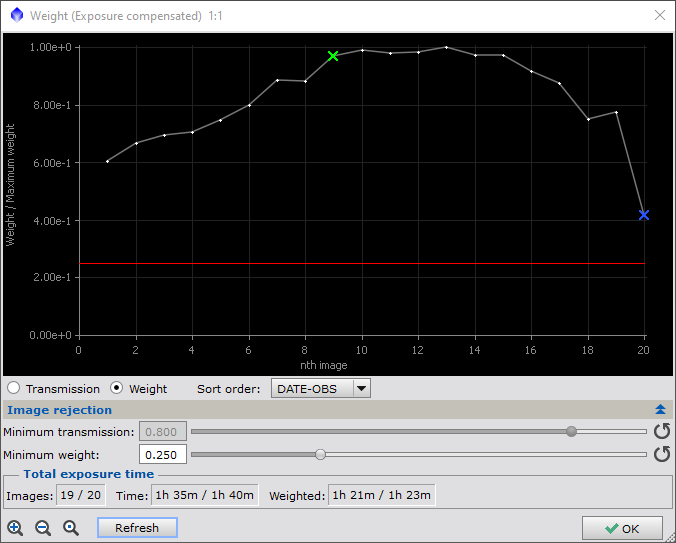
Weight graph: Specify image weight cut off.
The image weight is calculated from the (signal to noise ratio)².
This is affected by transmission, light pollution and camera noise.
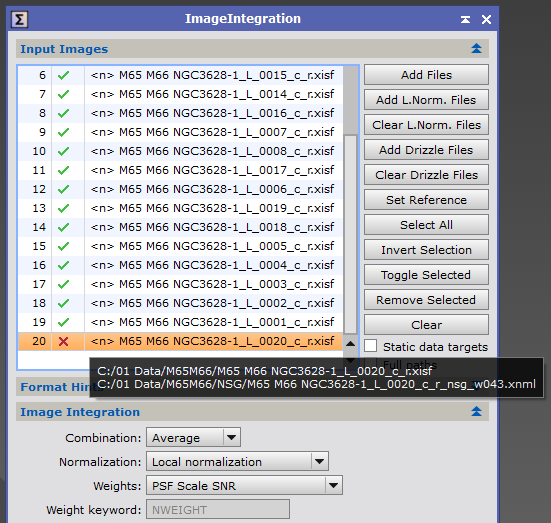
ImageIntegration: Displayed on NSG exit.
On NSG's exit,
ImageIntegration is invoked, configured to use NSG's results.
The Normalization is set to 'Local normalization' (In hindsight, I should probably have called NSG
'PhotometricLocalNormalization', but it's probably too late to change its name now).
ImageIntegration will use the *.xnml local normalization files that
NSG created. These files contain the
(brightness) scale factor and gradient correction; ImageIntegration will apply them to the target images.
The 'Weights' is set to 'PSF Scale SNR'. This instructs ImageIntegration to use the
weights that NSG calculated and stored within the *.xnml local normalization files.
The target files are added to ImageIntegration in order of decreasing weight.
Images that failed either the transmission or weight cutoff criteria are disabled with a 'x'.